
Views: 0 Author: Site Editor Publish Time: 2026-09-26 Origin: Site


Pneumatic systems operate under incredibly high stakes in sensitive environments. Oil contamination quickly leads to ruined samples, compromised pneumatic instruments, and severe compliance violations. You simply cannot afford to risk critical processes on subpar equipment. However, buyers face a significant challenge today. The market feels saturated with bold "oil-free" claims. Yet, performance, longevity, and true air purity vary drastically between standard industrial units and precision laboratory models. You need a reliable way to separate marketing jargon from engineering reality. This article provides a practical, objective framework for evaluating and comparing oil-free compressor pumps for laboratory equipment. We will examine compliance standards, technical specifications, and crucial integration requirements. By understanding these technical factors, you can confidently select the perfect model for your specific operational needs without falling for misleading spec sheets.
Purity verification is paramount: Genuine laboratory-grade models must comply with ISO 8573-1 Class 0 standards to guarantee zero oil vapor in the air stream.
Spec sheets hide duty cycle limitations: Comparing maximum pressure is less important than evaluating continuous vs. intermittent duty cycle capabilities.
Form factor and environment dictate design: Lab settings require specific acoustic treatments and thermal management that differ widely from open-floor industrial models.
Supplier capabilities matter for OEMs: Off-the-shelf solutions often fail to meet spatial or power constraints, making custom engineering capabilities a critical evaluation metric.
When specifying equipment for sensitive applications, we must establish a rigid baseline for air purity. Marketing departments frequently use phrases like "clean air" or "100% oil-less" loosely. These terms hold absolutely no regulatory weight and offer zero protection during a compliance audit. You must look for certified ISO 8573-1 Class 0 air purity. This internationally recognized standard legally guarantees that zero oil vapor enters your compressed air stream.
We need to clarify a vital technical distinction regarding these certifications. Some standard compressors operate without oil in the compression chamber but still utilize oil baths in their gearboxes or crankcases. In poorly ventilated spaces, ambient oil vapor from the crankcase can be ingested by the intake filter. True Class 0 certified systems eliminate this risk entirely. They ensure no oil exists anywhere within the system architecture.
Different pump mechanisms achieve this oil-free compression in unique ways. Understanding these fundamental technologies helps you match the hardware to your application.
Scroll Compressors: These utilize two spiral elements—one stationary and one orbiting. As the orbiting scroll moves, it continuously compresses air towards the center. This design involves very few moving parts, resulting in exceptionally smooth, quiet operation. They work incredibly well as an industrial oil-free compressor for high-demand facilities requiring large volumes of clean air.
Rocking Piston Pumps: These utilize a piston featuring a flexible cup seal that rocks back and forth inside a cylinder. They deliver impressively high pressure within a very small footprint. While they generate slightly more vibration, their size makes them perfect for space-constrained analytical instruments.
Diaphragm Pumps: A flexible membrane oscillates to draw in and expel air. Because the air never touches the mechanical drive components, they offer unparalleled leak tightness. They handle highly corrosive or dangerous gases exceptionally well, though they typically max out at lower flow rates.
Table 1: Comparison of Oil-Free Pump Technologies
Technology Type | Primary Mechanism | Key Advantage | Ideal Application Profile |
|---|---|---|---|
Scroll | Orbiting spiral elements | Low noise, continuous flow | Large-scale facility air supplies |
Rocking Piston | Flexible cup seal on piston | High pressure, compact size | Precision analytical instruments |
Diaphragm | Oscillating membrane | Extreme leak tightness | Corrosive or hazardous gas handling |
Many buyers make critical errors when interpreting spec sheets. Manufacturers often highlight the most impressive numbers, which rarely reflect real-world operating conditions. To procure reliable equipment, you must evaluate performance dynamically.
Follow these three steps to accurately evaluate compressor capabilities:
Evaluate flow strictly at operating pressure: Spec sheets prominently feature Free Air Delivery (FAD). This metric represents the volume of air produced when there is zero resistance in the system. However, pneumatic instruments always create backpressure. You must evaluate the Cubic Feet per Minute (CFM) or Liters per Minute (LPM) specifically at your required operating pressure (PSI or Bar). A pump boasting a massive FAD might suffer a severe flow drop when pushed to 90 PSI.
Scrutinize the true duty cycle: Maximum pressure ratings mean very little if the pump overheats in ten minutes. You must determine if a model supports continuous (100%) or intermittent duty. Intermittent models require cool-down periods, typically operating on a 50% duty cycle (e.g., 30 minutes on, 30 minutes off). We strongly warn against purchasing cheaper, intermittent-duty pumps for constant-demand applications. If your process runs continuously, it strictly requires a stable airflow compressor engineered with heavy-duty bearings and superior heat dissipation.
Implement downstream moisture and particulate management: An oil-free pump alone does not guarantee pristine air. Compressing ambient air inherently concentrates atmospheric moisture and dust. Buyers must evaluate the integrated filtration systems and desiccant drying stages. Without proper dryers, water vapor will condense inside your pneumatic tubing. This condensation quickly rusts internal instrument valves and ruins moisture-sensitive laboratory samples.
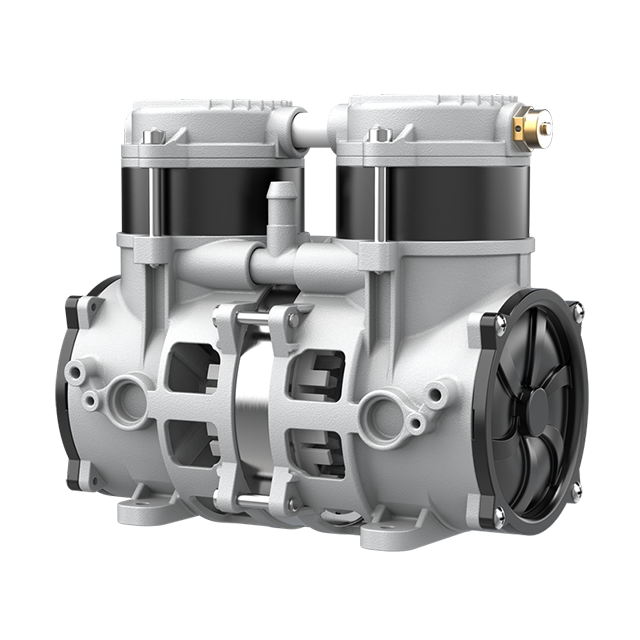
Integrating a compressor into a working environment involves more than just plugging it in. You must manage the physical byproducts of air compression: noise, size, and heat.
Lab environments demand aggressive noise mitigation. Standard industrial models routinely generate deafening noise levels above 80 decibels (dB). Placing one next to technicians causes severe fatigue and communication issues. Conversely, a true laboratory air compressor pump utilizes sophisticated sound-attenuating enclosures. These specialized acoustic cabinets trap high-frequency whining and keep operational noise well below 60 dB. You should also demand high-quality, vibration-isolating elastomer mounts. Low-frequency humming easily travels through workbenches and disrupts sensitive analytical scales.
Space constraints present a completely different set of integration hurdles. End-users and Original Equipment Manufacturers (OEMs) must carefully evaluate spatial footprints. When building complex machinery like nitrogen generators, ventilators, or dental delivery systems, internal space is incredibly scarce. In these scenarios, you often require a tightly engineered compact compressor head. This component must deliver robust pressure while fitting into awkwardly shaped, poorly ventilated chassis cavities.
This leads directly into thermal management. Oil-free pumps run inherently hotter than their oil-lubricated counterparts. They lack the cooling fluid bath that usually absorbs compression heat. Therefore, you must evaluate the cooling fan's aerodynamic efficiency and the motor's ambient temperature ratings. Check the manufacturer's maximum ambient temperature limit. If your equipment room lacks robust air conditioning, or if the OEM chassis restricts airflow, a poorly cooled pump will suffer catastrophic premature failure.
Initial procurement price represents only a fraction of the equipment's long-term operational footprint. You must evaluate the realistic lifecycle and maintenance requirements before making a final decision.
First, understand the true maintenance intervals. Many buyers mistakenly assume "oil-free" means "maintenance-free." While messy oil changes are completely eliminated, internal wear components still endure intense friction. Parts like PTFE (Teflon) piston rings, flapper valves, and cup seals run dry by design. They will inevitably wear down over thousands of hours. You must ask the manufacturer for realistic lifespan data on these specific consumables under your anticipated workload.
Next, evaluate the logistics of rebuilds versus full replacements. When seals eventually fail, you must decide how to restore pressure safely. Compare the availability and downtime associated with installing OEM rebuild kits against swapping in an entirely new unit. Rebuilding a pump takes skilled technical labor and halts your operations for hours. If downtime is unacceptable, keeping a spare, fully assembled pump on the shelf often proves more efficient than stocking individual O-rings and valves.
Finally, consider energy efficiency over a 5-to-10-year lifespan. Upgrading to direct-drive motors eliminates the mechanical transmission losses commonly found in older belt-driven models. For larger, high-capacity applications, Variable Speed Drive (VSD) technology dramatically impacts electrical consumption. A VSD model actively monitors system pressure and adjusts its motor RPM to match your exact air demand. This eliminates the massive energy waste associated with traditional fixed-speed pumps constantly starting and stopping under partial loads.
Procuring a reliable pump requires vetting the manufacturer just as rigorously as the hardware. This is especially true for engineers developing specialized OEM machinery.
During the prototyping phase, you need a flexible clean air pump supplier who deeply understands your niche. Standard, off-the-shelf products rarely fit complex integration requirements perfectly. Look for responsive engineering teams capable of delivering a custom lab equipment pump. The right partner will willingly modify motor voltages, adjust mounting bracket dimensions, or relocate intake and exhaust ports to match your unique chassis design seamlessly.
Supply chain transparency should also dictate your choice. Extended lead times easily cripple production schedules and delay product launches. Investigate where the manufacturer produces their equipment and where they store critical replacement parts. You need a partner with localized inventory and direct technical support. A cheaper pump loses all its appeal if a replacement valve takes six weeks to cross the ocean.
Always scrutinize warranty documentation and performance guarantees. Read the fine print carefully. Many manufacturers immediately void their warranties if the pump operates outside specific duty cycles or exceeds maximum ambient temperatures. You must ensure the written guarantee explicitly covers your intended real-world usage conditions, not just ideal laboratory testing scenarios.
Selecting the correct oil-free compressor requires a highly methodical approach. First, prioritize ISO 8573-1 Class 0 certified purity to strictly protect your sensitive analytical applications. Second, ensure the motor's duty cycle matches your actual continuous or intermittent usage patterns. Third, rigorously evaluate the long-term maintenance realities, energy consumption, and parts availability. Finally, verify that the acoustic enclosures and physical form factor fit seamlessly into your facility or OEM chassis.
Do not finalize any purchases based on generic marketing brochures. Take action by contacting your short-listed manufacturers today. Request detailed performance curves showing exact flow rates under your specific operating pressures. Ask for their internal thermal testing data during continuous, high-heat loads. We highly recommend consulting directly with an applications engineer to validate your sizing calculations before you proceed with procurement.
A: "Oil-free" typically indicates that no oil is used inside the actual compression chamber, preventing it from mixing directly with the air. However, the pump's gearbox or crankcase might still contain lubricating oil. "Oil-less" means there is absolutely no oil anywhere within the entire machine's architecture, removing all risk of ambient vapor contamination.
A: Lifespans vary significantly based on workload. Typically, high-quality PTFE or Teflon seals last between 2,000 to 8,000 operating hours. This range depends heavily on the continuous operating pressure, the ambient room temperature, and the specific pump mechanism. Always monitor flow rates, as gradual pressure drops indicate seals require rebuilding.
A: No, standard industrial models pose several risks. They generally lack the necessary internal hygienic coatings to prevent bacterial growth. They also produce excessive noise unsuitable for indoor workspaces and often lack the advanced, multi-stage desiccant drying systems required to remove moisture completely. Purpose-built medical variants are mandatory for safety and compliance.
A: Oil serves two functions in standard compressors: lubrication and sound dampening. The fluid bath absorbs significant mechanical noise and vibration. Because oil-free pumps lack this sound-dampening barrier, their internal components generate higher friction noise. This underscores the necessity of purchasing purpose-built models equipped with heavy-duty acoustic enclosures.


