
Views: 0 Author: Site Editor Publish Time: 2026-09-30 Origin: Site


Integrating a subpar compressor pump into your OEM equipment risks your brand's reputation. Downstream contamination and warranty liabilities can quickly erode customer trust. You need components you can rely on completely. Equipment failures in the field often trace back to poorly vetted pneumatic systems.
For sensitive applications like medical devices, pharmaceutical manufacturing, and food processing, the shift to oil-free pneumatics is non-negotiable. Sourcing a reliable oil-free compressor pump manufacturer requires looking far beyond basic spec sheets. You must evaluate supply chain resilience, engineering collaboration, and exact manufacturing tolerances. A spec sheet cannot prove long-term reliability.
This guide provides a hard-nosed, evidence-based framework for evaluating manufacturing partners. We will explore how to ensure long-term product viability and compliance. Read on to build a resilient, high-quality OEM supply chain.
Compliance is baseline: Demand verified ISO 8573-1 Class 0 certification, not just "oil-free" marketing claims.
Integration requires collaboration: A capable partner provides extensive prototype support and technical integration support to match your spatial, thermal, and power constraints.
Consistency over peak performance: High single-unit performance means nothing without rigorous batch consistency and end-of-line testing.
Lifecycle transparency: Evaluate suppliers based on realistic maintenance intervals (e.g., PTFE ring wear) rather than theoretical lifespans.
OEMs face strict regulatory environments across multiple industries. Downstream oil contamination can result in massive product recalls. In severe cases, it causes catastrophic equipment failure. You cannot afford ambiguity when selecting pneumatic components. Your chosen partner must understand these high stakes.
Assess whether the manufacturer can prove ISO 8573-1 Class 0 air purity. This standard dictates absolute zero added oil in the air stream. Look for transparent documentation regarding materials used in the air path. Anodized aluminum and stainless steel prevent rust and particulate shedding. You should always demand third-party test results to verify purity claims.
You must also acknowledge the physical trade-offs of oil-free technology. Oil-free units generate more heat than lubricated counterparts. They also often have higher noise profiles. Oil normally acts as a coolant and a dampener. Without it, managing thermals and acoustics becomes your responsibility. A trustworthy manufacturer will directly address these physical limitations. They will never hide them. They should provide realistic baseline data for thermal management.
Best Practices for Compliance Evaluation:
Request detailed material safety data sheets for all air-path components.
Ask for acoustic mapping data at various pressure loads.
Verify thermal rise data under continuous duty cycles.
Common Mistakes to Avoid:
Accepting internal lab results without third-party ISO verification.
Ignoring ambient temperature ratings during the design phase.
Failing to account for necessary ventilation inside the equipment enclosure.
Evaluating standard catalog items is only the first step. You must assess the manufacturer’s willingness to co-engineer solutions. Can they adjust motor mounting or port locations? Can they alter the footprint to fit tight OEM enclosures? True engineering partnerships require flexibility. You need deep technical integration support to overcome spatial limitations.
Look closely at their customization capabilities. Standard off-the-shelf models often fall short. They might not meet specific continuous flow (CFM) or peak pressure (PSI) requirements. Your partner should have the ability to design a custom compressor head. This custom approach ensures optimal stroke length and bore size for your application.
The prototyping phase separates genuine partners from basic vendors. Real-world testing within your specific enclosure is critical. Verify the manufacturer’s timeline for delivering these units. Do they provide expedited sample units for proof-of-concept testing? You also need to know how they handle iterative engineering feedback. A rigid supplier will resist design tweaks. A collaborative partner welcomes them. Prioritize vendors offering robust prototype support during early R&D.
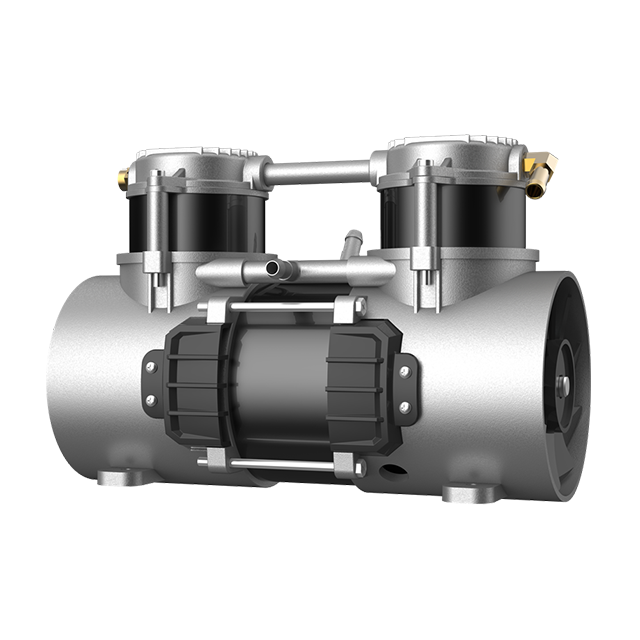
The transition from a perfect prototype to mass production is incredibly risky. This scale-up phase is where OEM partnerships often fail. A handmade prototype receives special attention. Mass-produced units do not. You must ensure the factory can replicate that initial quality thousands of times.
Investigate their specific manufacturing processes carefully. Ask about CNC machining tolerances for cylinders and pistons. These tolerances are absolutely critical in oil-free designs. Because there is no lubricating film, physical clearance dictates both wear rates and efficiency. If cylinders are machined out of round, piston seals will fail prematurely. You must verify their commitment to strict batch consistency.
Demand complete visibility into their testing regimen. Standardized oil-free pump quality control protocols protect your brand. Check if they conduct 100% end-of-line testing. Every single unit should be tested for pressure generation, current draw, and vibration. If they merely rely on statistical sampling, walk away. Statistical sampling allows defective units to slip through.
Scrutinize the quality of internal wear items. Pay special attention to PTFE cup seals and sealed bearings. These components dictate the maintenance schedule. A reliable manufacturer will transparently state their component lifecycle limits. They will base these limits on empirical wear data, not hopeful estimates.
QC Parameter | Basic Manufacturer (High Risk) | Premium OEM Partner (Low Risk) |
|---|---|---|
End-of-Line Testing | Batch sampling (1 in 50 units tested) | 100% individual unit testing for all metrics |
Machining Tolerances | Standard commercial variances accepted | Strict CNC tolerances verified by CMM machines |
Wear Part Tracking | Generic supplier sourcing for bearings/seals | Traceable lot numbers for premium PTFE and bearings |
Performance Documentation | General model spec sheet provided | Individual serial number test reports included |
Avoid the unit-price trap at all costs. A strictly low-cost pump often seems appealing during procurement. However, this decision quickly shifts expenses to post-sale warranty claims. Replacing a failed pump in the field costs far more than buying a premium pump upfront. Your reputation suffers severe damage when equipment breaks down.
You must understand real-world lifecycle maintenance realities. Oil-free pumps do require fewer routine fluid changes. They do not need oil top-offs or messy filter disposals. However, they rely heavily on the durability of frictionless coatings. They also depend entirely on permanently sealed bearings. You must evaluate the manufacturer’s data on rebuild intervals carefully. Compare a pump requiring service at 5,000 hours against one lasting 10,000 hours. The longer-lasting unit provides significantly more value to your end-user.
Assess their supply chain capabilities for spare parts. Can they reliably supply proprietary replacement parts? You need maintenance kits available over the entire 5 to 10-year expected lifespan of your OEM equipment. A pump is useless if you cannot source replacement piston seals three years from now. Ensure your partner has a robust inventory management system to support legacy models.
Vendor consolidation simplifies your supply chain. You must define specific criteria to filter your shortlist of potential partners. Do not rely on marketing brochures. Use hard data to make your final selection.
Execute an RFQ stress test when engaging any potential OEM compressor pump supplier. You need to ask difficult questions early in the process. This separates capable manufacturers from mere distributors.
Essential Audit Steps:
Request historical defect rates measured in Parts Per Million (PPM). Anything above a recognized industry threshold should raise alarms.
Ask for detailed case studies of similar OEM integrations. Ensure they have proven private label capabilities if you require branding.
Demand to see contingency plans for supply chain disruptions. Ask how they handle sudden motor sourcing shortages or raw material delays.
Review their localized support network. Ensure they have engineers available in your primary time zones.
Finally, define the clear pathway forward. Start with an initial Non-Disclosure Agreement (NDA). Move toward a comprehensive site audit of their manufacturing floor. Finish with immediate prototype procurement for internal lab testing.
Selecting the right manufacturing partner is a highly strategic business decision. It directly impacts your equipment’s market viability, regulatory compliance, and overall profitability. You cannot treat compressor pumps as generic commodities. They are critical life-blood components for your pneumatic systems.
Always prioritize manufacturers who offer completely transparent engineering data. Seek out partners with proven, trackable quality control frameworks. They must demonstrate a genuine willingness to act as an extension of your own R&D team. Long-term success requires mutual trust and verifiable engineering excellence.
Stop risking your brand on unverified components. Contact your engineering team today to schedule a technical consultation. Request a customized prototype and carefully review long-term OEM pricing structures to secure your supply chain.
A: Standard lead times typically range from 4 to 8 weeks. This timeline depends heavily on the complexity of your custom requirements. Adjusting mounting points is fast. Engineering a completely new head for specific pressure demands takes longer. Expedited options often exist for urgent proof-of-concept projects.
A: Yes, reputable manufacturers offer extensive white-label capabilities. They can match your specific brand colors using custom painting. They also provide branded nameplates and customized packaging. This ensures the internal components seamlessly match your overarching equipment brand identity.
A: The manufacturer normally covers defects in materials and workmanship. The OEM handles field replacement labor. A strong partner will perform a detailed root-cause analysis on returned units. They offer clear replacement terms to keep your end-users operational while the investigation occurs.
A: Yes, they absolutely do. Because they lack cooling oil, these pumps generate concentrated heat. You must provide active ventilation, such as exhaust fans or louvered panels, inside your enclosure. Proper airflow prevents premature failure of the internal sealed bearings and PTFE seals.


