
Views: 0 Author: Site Editor Publish Time: 2026-09-19 Origin: Site


Operating high-end aesthetic devices requires precision pneumatics to ensure flawless clinical outcomes. Generic industrial air compressors introduce unacceptable risks of oil contamination, disruptive noise, and inconsistent airflow. Such systems compromise both client safety and spa hygiene standards. For OEMs and clinic operators, selecting the right pneumatic engine remains a strict balancing act. You must protect client safety, maintain atmospheric ambiance, and guarantee continuous operational reliability. A sudden failure mid-treatment harms your reputation and disrupts daily schedules. Evaluating these pumps requires moving past basic marketing claims. We must focus on three verifiable engineering pillars instead. You will learn how to assess pressure stability, acoustic output, and thermal duty cycle. This guide will help you specify the exact pump required for your clinic or manufacturing line.
100% Oil-Free is Non-Negotiable: Pure air delivery prevents micro-droplet contamination on clients' skin and protects internal aesthetic device valves.
Volume Trumps Peak Pressure: A stable pressure air source relies on matching the pump’s CFM (Cubic Feet per Minute) to the continuous draw of the beauty equipment, not just static PSI.
Acoustic Targets Matter: A true low noise compressor pump for spa environments must operate below 60 dB to maintain client relaxation.
Duty Cycle Dictates Lifespan: Undersized pumps running past their duty cycle limits will overheat, causing premature failure during back-to-back client treatments.
Oiled compressors create a severe problem in clinical environments. They constantly aerosolize microscopic oil lubricants into the airstream. Filtration systems catch most liquid, but vaporized oil still escapes. In aesthetic applications like oxygen facials, airbrush cosmetics, and spray tanning, this vapor travels directly onto the client. Oil micro-droplets cause localized skin reactions. They ruin makeup adhesion and lead to uneven tanning applications. Furthermore, blowing oil vapor into a clinical space violates basic hygiene compliance standards.
You can avoid these hazards by utilizing oil-free air compressor pumps for beauty equipment. These advanced units replace liquid lubrication entirely. They use PTFE (Teflon) coated pistons or oscillating diaphragms instead. The PTFE coating provides inherent lubricity. It reduces internal friction between the piston and the cylinder wall. Diaphragm models flex back and forth to draw and push air. They never rely on metal-on-metal sliding contact. Both designs guarantee 100% pure air delivery.
Eliminating oil removes massive maintenance burdens. Clinic staff no longer need to perform messy oil changes. Operators can also stop monitoring downstream oil-water separators. Removing these maintenance tasks minimizes operator error. A pristine airline protects sensitive proportional valves inside expensive aesthetic lasers. It keeps internal tubing free from sludge buildup. Consequently, your aesthetic equipment runs longer and cleaner.
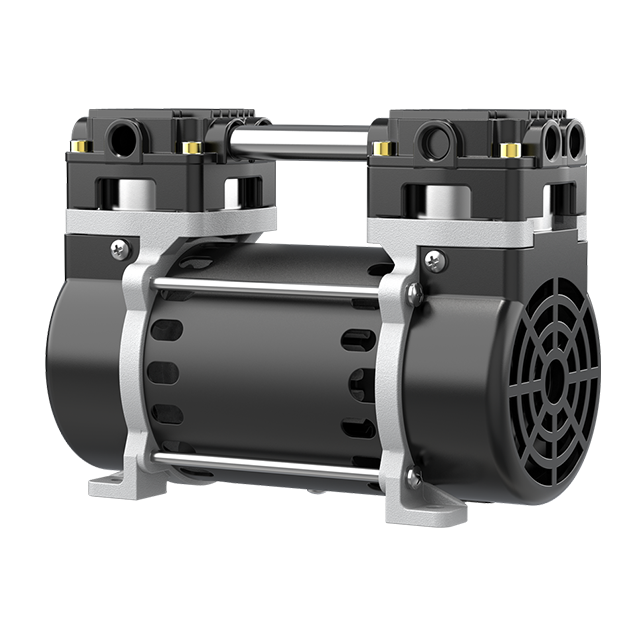
Professionals often misunderstand pneumatic metrics in beauty applications. Many buyers look for high PSI (Pounds per Square Inch). However, aesthetic equipment typically operates at low pressures between 15 and 40 PSI. These devices actually demand high, sustained volumetric flow. We measure this flow in CFM (Cubic Feet per Minute). A high PSI rating means nothing if the pump cannot sustain the required CFM. You must prioritize volume over peak pressure to achieve a stable pressure air source.
An undersized pump fails to keep up during continuous treatments. This causes a sudden pressure drop. When pressure drops, airbrush applicators begin sputtering. Microdermabrasion tools lose their suction power instantly. Sputtering ruins a flawless cosmetic application. Weak suction leaves exfoliating crystals on the client's skin. You must properly match the pump's CFM output to the tool's maximum draw.
You also need to evaluate receiver tanks versus direct-drive systems. Some treatments need a small buffer tank. A tank stores compressed air and smooths out pneumatic pulsations. It guarantees a surge-free experience for delicate facial procedures. Conversely, continuous-flow diaphragm pumps work well for direct-drive setups. They output smooth air without a bulky tank. Choosing the right aesthetic device air pump depends heavily on your specific application.
Aesthetic Application | Required Pressure (PSI) | Required Flow (CFM) | Recommended Pump Type |
|---|---|---|---|
Airbrush Makeup | 15 - 25 PSI | 0.5 - 1.0 CFM | Direct-drive diaphragm |
Oxygen Facials | 20 - 30 PSI | 1.5 - 2.5 CFM | Piston pump (tankless) |
Microdermabrasion | 30 - 45 PSI | 2.0 - 3.5 CFM | Piston pump with receiver tank |
Cryotherapy Cooling | 40 - 60 PSI | 3.5 - 5.0 CFM | Dual-piston with large tank |
Noise stands as a primary conversion killer in high-end spas. Clients pay for tranquility and relaxation. A loud mechanical rumble shatters this atmosphere instantly. Anything operating above 65 decibels (dB) interrupts client relaxation. It also forces the operator to shout over the equipment. You must install a genuine low noise compressor pump to preserve the spa environment.
Implementing a quiet system goes beyond the base decibel rating. We must address vibration and resonance. A pump might test quietly in a lab. However, mounting it against a hollow wooden spa cabinet creates a resonant drum effect. Low-frequency vibrations travel through floors and walls. Therefore, how you mount a beauty equipment compressor dictates its real-world acoustic performance.
Use strict evaluation criteria when comparing noise levels. Follow these guidelines to ensure genuine acoustic compliance:
Look for sub-60 dB ratings: The pump must maintain this level at full mechanical load, not just while idling.
Insist on isolated motor mounts: Elastomer dampeners prevent kinetic energy from transferring into the chassis.
Demand specialized intake silencers: Air rushing into the pump creates intense hissing. Quality silencers baffle this high-frequency noise.
Verify the testing distance: Perform a skeptical check on all spec sheets. Manufacturers often inflate "quiet" claims by testing at 3 meters. A 60 dB rating at 3 meters sounds much louder when placed 1 meter from a treatment chair.
Understanding duty cycle prevents catastrophic equipment failure. Duty cycle represents a percentage metric measuring run time. It dictates how long a pump can operate within a one-hour window. For example, a 50% duty cycle means the pump can run for 30 minutes. It must then rest and cool down for the remaining 30 minutes. Ignoring this limit destroys the internal motor windings.
Different clinic devices place different demands on compressed air. You must evaluate continuous versus intermittent demand. Oxygen concentrators and continuous airbrush spray systems never stop during a session. They require heavy-duty pumps rated for 100% continuous duty. Conversely, intermittent devices only draw air in short bursts. Pneumatic massage tools and spot-cooling jets fall into this category. These devices can safely utilize lighter 30% to 50% duty cycles.
Thermal management is the most critical factor for longevity. Oil-free models inherently run hotter than oiled counterparts. Liquid oil acts as a coolant in traditional industrial pumps. Without oil, PTFE-coated pistons rely entirely on ambient air for cooling. Running an undersized pump past its duty cycle limit creates immense thermal risks.
Implement the following thermal management strategies:
Verify thermal overload protection: Ensure the motor includes an automatic shutoff switch. This switch cuts power if internal temperatures exceed safe limits. It prevents catastrophic motor fires.
Ensure adequate chassis ventilation: Never install a bare pump inside a sealed, unventilated spa cabinet. Ambient heat will pool around the motor.
Install auxiliary cooling fans: High-volume clinics running back-to-back appointments should point extraction fans toward the compressor housing. This forcefully removes trapped heat.
The sourcing process looks very different depending on your business model. Clinic owners typically buy standalone, boxed compressors. They plug these finished units directly into the wall. Medical and aesthetic device manufacturers have different needs. They require bare, integrated pumps to build into their laser chassis. A reliable beauty equipment pump supplier must understand both OEM requirements and aftermarket realities.
When sourcing a custom compressor pump, you must demand specific customization dimensions. Off-the-shelf units rarely fit perfectly into proprietary aesthetic devices. Sourcing for international markets requires custom voltages (110V vs 220V). Compact cosmetic lasers demand bespoke footprint dimensions to save internal space. You may also need proprietary mounting brackets to align with your existing chassis layout. Discuss these engineering modifications early in the negotiation phase.
Look for concrete supplier trust signals before signing a contract. Marketing promises cannot replace traceable compliance certifications. Your supplier must provide current CE and RoHS documents. If your equipment crosses into dermatological treatments, look for ISO 13485 certification. This indicates strict medical-grade manufacturing overlaps. Demand transparent warranty terms specifically covering wear items like piston rings and flapper valves. Finally, insist on prototype testing units. A trustworthy supplier will ship a sample pump so your engineering team can validate flow rates and thermal limits in a real-world lab setting.
Specifying oil-free air compressor pumps for beauty equipment requires a strict technical approach. You must prioritize absolute air purity to protect clients and internal valves. Acoustic dampening ensures your spa environment remains relaxing and professional. Rigorous duty-cycle matching prevents overheating during your busiest operating hours.
Take immediate action to secure the right pneumatic engine. First, calculate the absolute maximum CFM and PSI requirements of your specific aesthetic devices. Next, map out your daily treatment volume to determine the necessary duty cycle percentage. Finally, request detailed technical spec sheets and verifiable noise test data from your shortlisted manufacturers.
A: These pumps generally require maintenance every 2,000 to 4,000 operating hours. Your exact schedule depends heavily on daily usage and ambient clinic conditions. You must replace the intake filters regularly to prevent dust buildup. You also need to replace the PTFE piston rings and flapper valves once they wear down and cause pressure drops.
A: Yes, you can use a dental compressor. They provide excellent clean, dry air and operate very quietly. However, they are generally over-engineered for standard aesthetic clinics. Dental compressors include expensive desiccant dryers and specialized medical-grade coatings. This makes them highly cost-prohibitive compared to dedicated beauty equipment compressors.
A: A continuous oxygen facial machine requires an 80% to 100% continuous duty rating. These treatments draw steady, uninterrupted airflow for extended periods. Using a pump with a standard 50% duty cycle will cause rapid overheating. This ultimately leads to thermal failure mid-treatment.
A: You can isolate kinetic energy by installing heavy-duty anti-vibration rubber mounts under the pump feet. Replace rigid plastic tubing with flexible braided hosing to stop vibrations from traveling into your handpieces. Finally, place the unit inside a ventilated acoustic enclosure lined with sound-dampening foam.


