
Views: 0 Author: Site Editor Publish Time: 2026-09-23 Origin: Site


Compromised compressed air introduces severe clinical and business risks to any dental practice. Contaminated air causes sudden handpiece failure during critical procedures. It elevates patient infection risks by blowing pathogens directly into open cavities. Furthermore, moisture and microscopic debris quickly ruin expensive bonding agents, leading to failed restorations. Traditional oiled compressors once dominated mechanical rooms across the industry. Today, stringent hygiene protocols and modern materials require completely pure air. This shift makes a reliable dental oil-free air compressor pump a mandatory baseline for modern clinics.
You simply cannot afford the liability of oil mist entering a patient's airway. This article serves as a practical evaluation guide for practice owners and procurement managers. We will help you navigate strict compliance standards seamlessly. You will learn how to accurately calculate your operational air requirements. Finally, we will show you how to shortlist reliable equipment without overspending on unnecessary features.
Compliance is Non-Negotiable: Oil-free designs are mandatory for preventing microbial growth and oil vapor contamination in patient airways and restorative materials.
Sizing Dictates Longevity: Undersized pumps run continuously, leading to premature motor burnout; exact CFM (Cubic Feet per Minute) to chair-count ratios are critical.
Noise vs. Power Trade-offs: Advanced acoustic cabinets and scroll technologies have solved the historical issue of excessively loud oil-free operations.
Supplier Vetting: Choosing the right manufacturer involves assessing aftermarket support, part availability, and OEM customization capabilities for specialized dental units.
Microscopic oil carryover poses a massive threat to modern clinical outcomes. Dental professionals rely heavily on composite resins for restorations. These resins require a perfectly dry, contaminant-free tooth surface to bond correctly. Even a microscopic drop of oil mist degrades this delicate bond instantly. The restoration will inevitably fail, forcing the patient to return for corrective work. This damages your clinic's reputation and wastes valuable chair time. Furthermore, oil carryover damages the delicate turbine bearings inside expensive dental handpieces. These tools require pristine air to spin at hundreds of thousands of RPMs safely.
Upfront prices for advanced pneumatic technology might seem daunting initially. However, you must perform an operational reality check. Compare the initial cost of an oil-less compressor for dental equipment against the hidden burdens of older lubricated units. Oiled compressors demand frequent oil changes. They require specialized filtration add-ons to capture migrating oil sludge. More importantly, they present a constant risk of catastrophic clinical downtime. When oil sludge clogs the main air lines, the entire clinic shuts down. Switching to unlubricated technology completely eliminates the liability of hazardous waste disposal for used oil.
You must also evaluate your equipment through the lens of strict regulatory compliance. The ISO 8573-1 standard dictates compressed air purity for medical and dental environments. Dental applications generally require Class 0 or Class 1 air quality. This means zero tolerance for liquid oil or oil vapor. A high-quality clean air dental compressor meets these strict baseline standards effortlessly. It provides absolute peace of mind during health and safety audits.
Audit your air lines annually for signs of residual oil from older equipment.
Install point-of-use micron filters near sensitive milling machines.
Document your air quality compliance to satisfy local health board inspections.
Selecting the correct mechanical architecture determines how smoothly your utility room operates. Manufacturers design different compression mechanisms to handle specific clinical demands. You must align your practice size with the right underlying technology.
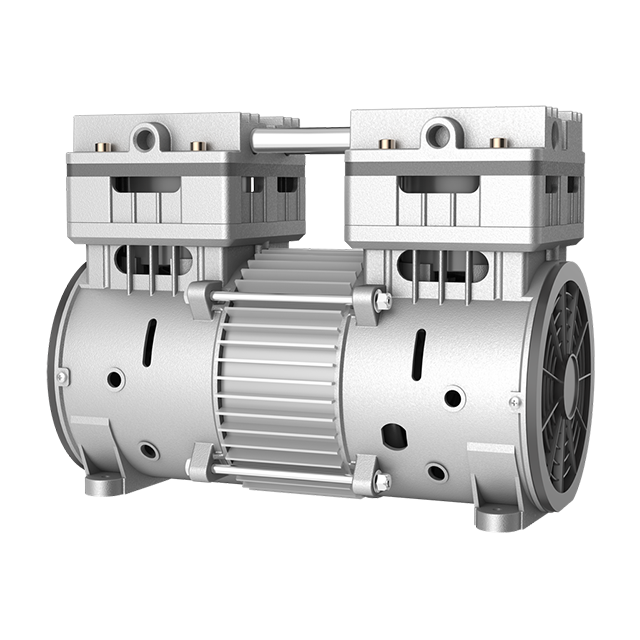
Piston compressors utilize specialized Teflon-coated rings to generate pressure. These rings slide up and down inside the cylinder without needing liquid lubrication. This mechanism is highly robust and mechanically straightforward. It is best suited for standard multi-chair practices prioritizing budget and simple maintenance. If a component fails, technicians can easily source and replace the specific parts. However, piston units naturally generate more vibration than other designs. They require adequate structural mounting to prevent excessive shaking.
Scroll compressors operate using two interlocking spiral vanes. One scroll remains completely stationary while the other orbits around it. This continuous orbital motion squeezes the air into tighter spaces, increasing pressure steadily. Scroll technology delivers ultra-smooth, vibration-free air without the pulsation typical of piston models. This architecture is best for busy clinics requiring a 100% duty cycle. Large dental laboratories or practices running continuous CAD/CAM milling machines benefit greatly from scroll units.
Buyers often face confusion when upgrading their pneumatic infrastructure. You must differentiate between buying a replacement dental air compressor pump and procuring a fully integrated system. A bare pump consists solely of the motor and the compression head. You buy this when your existing tank and dryers remain in excellent condition. Conversely, a complete system arrives fully integrated. It includes the bare pump, a receiver tank, desiccant dryers, and an automated control board. If your current tank shows signs of internal rust, you must replace the entire integrated system immediately.
Accurately sizing your equipment prevents early mechanical failures and ensures consistent air delivery. You must calculate precise performance metrics based on your daily clinical operations. Guessing these numbers leads directly to burned-out motors or inadequate suction.
You need to understand CFM (Cubic Feet per Minute) and PSI (Pounds per Square Inch). PSI represents the force of the air, while CFM represents the volume. A common rule of thumb dictates about 2.0 to 2.5 CFM at 80 PSI for each active dental chair. Once you calculate your baseline, you must add a 20-30% performance buffer. This extra capacity handles simultaneous high-volume evacuation (HVE) use. It also provides breathing room if you decide to add another treatment chair next year.
Duty cycle realities dictate the lifespan of your investment. A compressor's duty cycle measures how long it runs compared to how long it rests. You should size your system so the pump never runs more than 50-60% of the time. If your unit runs constantly, it indicates an undersized system. Constant running generates immense heat. This heat melts internal Teflon seals and accelerates mechanical wear rapidly.
Acoustic considerations also require careful planning. Dental utility rooms often share thin walls with patient treatment areas. Loud, knocking machinery increases patient anxiety and causes staff fatigue. You must evaluate the need for a low noise dental compressor operating under 65 decibels (dB). If you buy a louder piston unit, you must implement mitigation strategies. Sound-dampening acoustic enclosures trap the noise effectively. Alternatively, you can purchase inherently quiet scroll pumps to solve the noise problem completely.
Standard Sizing Guidelines
Practice Size | Active Chairs | Recommended CFM (at 80 PSI) | Ideal Pump Architecture |
|---|---|---|---|
Small Clinic | 1 - 2 | 5.0 - 6.0 CFM | Single-head Piston |
Medium Practice | 3 - 5 | 10.0 - 13.0 CFM | Dual-head Piston or Small Scroll |
Large / Surgical | 6 - 10+ | 20.0+ CFM | Multi-head Scroll System |
Adopting an oil-free system solves contamination problems, but it introduces specific post-purchase realities. You must manage these risks proactively to protect your investment. Ignorance of basic physics will lead to severe equipment degradation.
The greatest implementation risk is the moisture threat. An unlubricated pump solves the oil problem, but it cannot stop the water problem. Ambient air contains humidity. Compressing that air naturally squeezes out the moisture, creating condensation. Delivering wet air to handpieces causes internal tank rust and destroys restorative materials. To prevent this, you must insist on integrated desiccant dryers. These dryers absorb moisture before the air reaches the clinic. Additionally, automatic tank drains are mandatory. They expel accumulated liquid water daily without relying on staff memory.
You must also reject the skeptical "zero maintenance" myth. Many sales brochures imply that oil-free equates to maintenance-free. This is entirely false. You still need a disciplined maintenance schedule to prevent catastrophic failures. Common maintenance tasks include replacing intake air filters every six months. A clogged intake filter starves the pump of air, forcing it to work twice as hard. You must also check the auto-drain valves regularly for clogs. Finally, desiccant bead columns require periodic replacement when they become fully saturated with moisture.
Life expectancy ties directly to thermal management inside your utility room. Friction generates extreme heat. In unlubricated systems, cooling fans and adequate room ventilation dictate the lifespan of internal Teflon rings. If you lock your unit in a tiny, unventilated closet, ambient temperatures will skyrocket. High ambient heat softens internal seals and destroys the motor prematurely. Always ensure cross-ventilation or install a dedicated exhaust fan in your mechanical room.
Placing the air intake near a vacuum exhaust line, pulling contaminated air back into the system.
Ignoring a dripping auto-drain valve until the main receiver tank rusts through.
Assuming a 100-gallon tank compensates for a severely undersized motor pump.
Procuring heavy dental machinery requires intense supply chain scrutiny. You are not just buying a metal box; you are entering a long-term B2B partnership. Shortlisting the right vendor ensures your clinic remains operational for the next decade.
Component traceability stands out as a major vetting criteria. You need to know where the critical parts originate. The origin of the motor windings and the compression head matters for long-term reliability. Cheap, untraceable components inevitably fail under the stress of daily clinical use. Ask your vendor direct questions about their sourcing. Reliable manufacturers proudly display their engineering origins and compliance certifications.
Large-scale distributors and dental chair manufacturers require advanced technical partnerships. You must evaluate an OEM dental compressor partner based on their customization capabilities. A strong OEM partner adapts to your specific chassis constraints. They can customize voltage configurations for different international markets. They can also redesign intake manifolds to fit inside custom soundproof cabinets. This flexibility separates a basic hardware vendor from a true strategic manufacturing partner.
Finally, closely review the warranty and Service Level Agreement (SLA). When evaluating a dental equipment pump supplier, look past the initial purchase price. Examine the fine print. A trustworthy supplier covers the main pump head for at least three to five years. They also guarantee rapid aftermarket parts availability. If a pressure switch breaks, you need a replacement shipped overnight. Extended shipping delays cause unacceptable clinical bottlenecks.
Transitioning to an oil-free pneumatic system represents a profound investment in clinical predictability and patient safety. Modern dental restorations and strict infection control protocols leave no room for compromised air quality. Removing lubricated machinery from your utility room instantly eliminates the risk of oil mist ruining your expensive composite bonds.
We strongly advise buyers to prioritize correct CFM sizing and integrated moisture drying above all else. Do not simply hunt for the cheapest bare unit on the market. An undersized, wet system will fail prematurely and cost you thousands in delayed treatments and unhappy patients. Focus heavily on proper thermal management and diligent intake filter maintenance to maximize your equipment's lifespan.
Take proactive steps today to secure your operational future. Audit your current chair count and calculate your exact simultaneous air consumption. Inspect your existing utility room for adequate ventilation and power supply. We encourage you to contact a specialized pneumatic supplier for a custom, no-obligation evaluation of your specific clinical requirements.
A: A high-quality unit typically lasts 10 to 15 years. However, this lifespan assumes you properly sized the equipment so the duty cycle remains under 50%. It also assumes you strictly follow maintenance schedules, such as changing intake filters annually and ensuring the utility room stays well-ventilated.
A: Historically, yes. They naturally produce more noise due to the higher friction of unlubricated moving parts. However, modern engineering has largely solved this. Advanced acoustic sound-dampening cabinets and vibration-free scroll technologies have made them virtually silent and perfectly suitable for quiet clinical settings.
A: Yes, you certainly can. Equipment suppliers frequently sell bare pumps specifically for retrofitting older systems. You must first ensure your existing receiver tank is completely rust-free. Additionally, the pressure switch ratings and electrical configurations must match the new pump exactly.
A: The lack of oil does not stop natural water condensation. If you see water, it indicates a secondary failure. You likely have a failing desiccant dryer column, a broken automated tank drain, or poor room ventilation. Overheating causes the air to hold excessive moisture that bypasses the drying system.


